Skip to content

Ballyclare · BT39

Plumbers in
Ballyclare.

Ballyclare is a market town 10 miles north of Belfast. The town proper is on Phoenix gas; the surrounding villages and agricultural fringe (Straid, Doagh, Parkgate, Kilbride) stay oil-heated and feed regular OFTEC servicing. Elevation means condensate-freeze is a reliable winter call-out.

Gas Safe registered | OFTEC registered | 10+ years on the tools
Boiler work in Ballyclare, Belfast

About the area

Town on gas, farms on oil, everything gets colder at elevation. Condensate-freeze is the Ballyclare winter call-out.

Ballyclare sits on Phoenix Natural Gas for the town core and immediate suburbs; rural BT39 remains oil-dominant. The town is at ~70m elevation which affects both mains-water pressure at peak demand and winter condensate behaviour. Farm properties often run multi-boiler setups (house plus outbuildings) which don't fit standard domestic quoting templates.

Ballyclare became part of merged Antrim and Newtownabbey borough in 2015 but retains small-market-town character rather than suburban-Belfast feel. The centre has Georgian and Victorian stock around Main Street and Market Square; residential expansion from the 1980s filled estates off the Doagh, Templepatrick and Belfast Roads. Larger detached homes sit along Ballycorr and Rashee elevations. Phoenix connected Ballyclare in the mid-2000s and has expanded gradually since. The agricultural fringe (Straid, Doagh, Parkgate, Kilbride) remains oil-heated, and larger farm properties commonly run multiple heating sources.

Gas network
Phoenix Natural Gas
Drive time
20 minutes from Belfast city centre
Postcodes covered
BT39
Main focus
Oil to Gas Conversion · Gas Boiler Installation · Oil Boiler Servicing

How we work here

What Ballyclare homes need.

Every area has its own housing stock and heating mix. Here's how that shapes the work we do in Ballyclare.

Housing stock

Georgian and Victorian stock along Main Street and around Market Square; 1980s-2000s private estates off the Doagh, Templepatrick and Belfast Roads; larger detached homes along Ballycorr and Rashee elevations; rural bungalows and farmhouses through the BT39 countryside.

Heating pattern

Phoenix Natural Gas in the town core (roughly 70% of BT39 urban stock). Oil-dominant across Straid, Parkgate, Kilbride and wider rural. Combi boilers on newer estates, system + cylinder in larger homes, Grant / Warmflow / Firebird oil on farms.

Common jobs in Ballyclare

  • Gas combi replacements across 1990s-2000s estate stock hitting the 15-20 year mark.
  • Oil-to-gas conversions where Phoenix has recently extended mains.
  • OFTEC oil servicing across Straid, Parkgate, Kilbride and rural-fringe properties.
  • Agricultural multi-boiler servicing (house + outbuilding + workshop heating).
  • Condensate pipe insulation and rerouting on elevation-affected properties.
  • Power flushing on 20+ year old systems with sludge throttling circulation.
  • Landlord CP12s in the town-centre rental stock.

Local considerations

Things to know in Ballyclare.

Ballyclare's elevation (much of the town sits 60-80m, upper Ballycorr / Rashee above 100m) means winter cold snaps register colder than Belfast proper. Uninsulated external condensate pipes reliably freeze and cause lockouts; insulating at install prevents repeat emergency call-outs.

Farm properties around Kilbride, Doagh and Straid often run zoned multi-boiler layouts: one boiler for the house, separate systems for outbuildings, workshops or milking parlours. These don't fit domestic quoting and need individual site surveys.

Phoenix network extensions continue episodically. Before committing to a new oil boiler for a property in the BT39 town spine, it's worth checking current coverage.

Housing stock in depth

Property types and what they need.

Ballyclare is not one kind of house. Each era has a different pipework shape, different failure modes, and a different correct answer on replacement. Here's how that plays out on the ground.

01 · c. 1800-1910

Town-centre Georgian / Victorian stock

BT39

Period terraces, townhouses and small commercial premises around Main Street and Market Square. Solid brick or stone, slate roofs, some original sash windows and chimney stacks.

Typical setup

Where modernised, a combi in a rear kitchen or utility. Pipework mixed across eras. Flue routing constrained by the market-town street proportions.

Common issues

  • Lead supply pipe from the main still present in some properties.
  • Flue positioning constrained by conservation considerations on main street elevations.
  • Condensate discharge routing through party walls or to restricted rear yards.
  • Original cast-iron soil stacks on older properties.

Best practice on replacement

Rear-elevation flue routing where possible. Replace internal stopcock. Check Listed Building Consent for any listed property near Market Square. Low-temperature flush on any retained cast-iron rads.
02 · c. 1985-2005

1980s-2000s private estate

BT39

Three- and four-bed private estate homes off Doagh Road, Templepatrick Road and Belfast Road. Detached and semi-detached, 95-135 sqm, integral garage common.

Typical setup

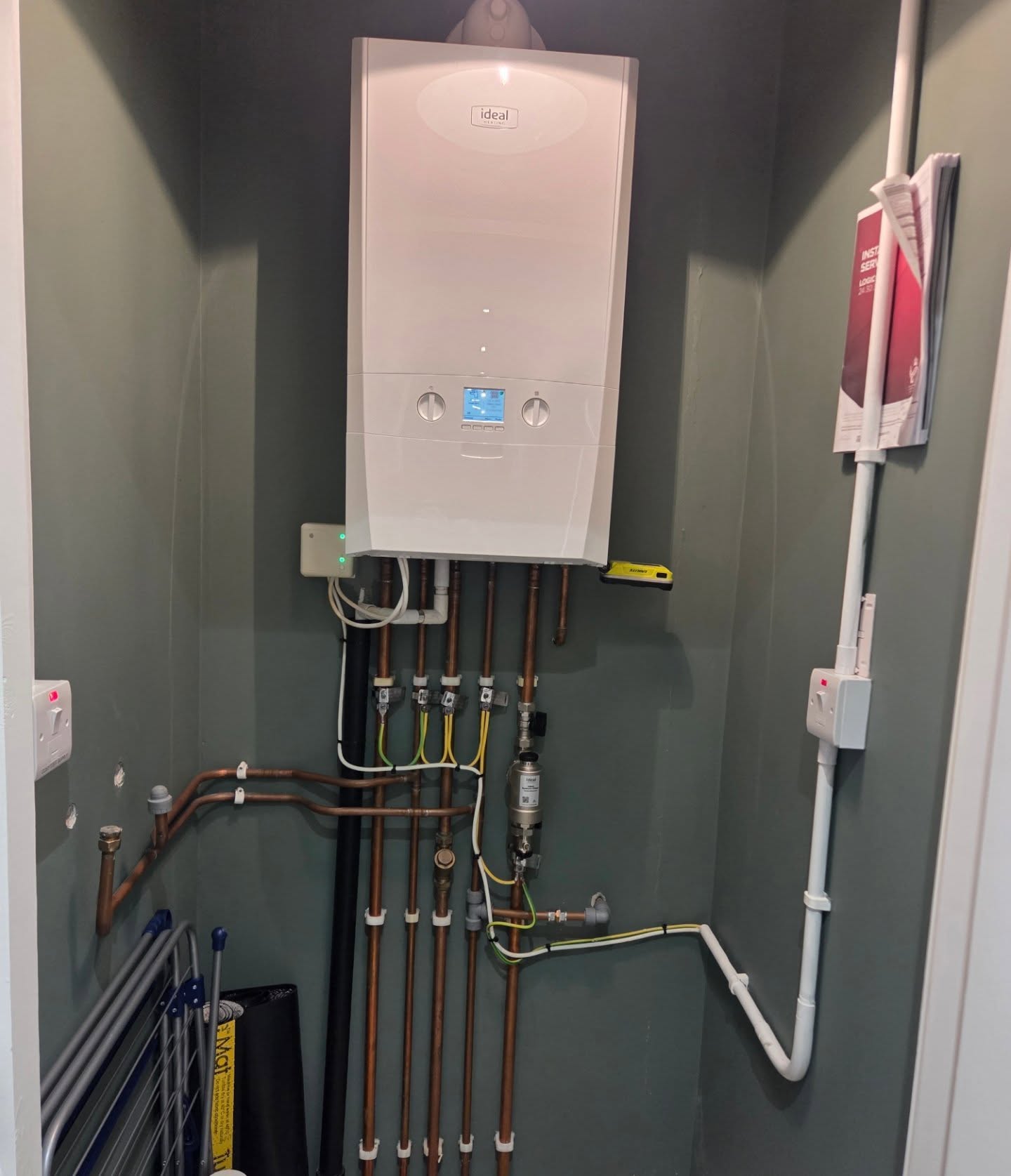
Combi or system boiler from original build or first upgrade. Modern 15mm / 22mm copper pipework. Radiators correctly sized at build. Garage or kitchen boiler siting.

Common issues

  • Original boiler hitting 20+ years with parts narrowing.
  • External condensate freezing in elevation-affected cold snaps.
  • Magnetic filter absent on pre-2012 installs.
  • Garage-sited boiler frost-protection absent.
  • Filling loop left as flexi-hose permanently.

Best practice on replacement

Like-for-like swap with magnetic filter. Condensate insulation or internal rerouting. Frost-stat on garage installs. Fixed filling loop. Smart thermostat retrofit option.

03 · c. 1950-2005

Rural BT39 oil-heated bungalow or farmhouse

BT39

Detached bungalows and farmhouses across Straid, Parkgate, Kilbride, Ballyutoag and the wider Ballyclare countryside. External oil tank, internal or external boiler, often longer radiator circuits than town stock. Some properties run multi-boiler setups for outbuildings.

Typical setup

Grant Vortex, Warmflow Professional, Firebird Envirogreen oil boiler. Open-vent or sealed primary. Bunded or single-skin oil tank 1,000-2,500L. Multi-boiler agricultural properties may have separate heating for dairy, workshop or barn.

Common issues

  • Single-skin oil tank pre-2003 bunding regs.
  • Exposed external pipework freezing at elevation.
  • Multi-boiler interconnects done historically without proper zoning controls.
  • Burner nozzle size drift over years of deferred servicing.
  • Farm boilers running extended duty cycles, shortening component life.

Best practice on replacement

Bunded tank to current OFS T100 spec. Match burner nozzle to current heat exchanger. Proper zone controls on multi-boiler farm setups. Insulate external pipework. Annual OFTEC service baseline.

Technical constraints

Pressure, flues and planning.

The bits of a boiler install that determine whether your quote is realistic or optimistic. Most of these are checked at survey, not after.

Mains pressure and flue routing

NI Water mains pressure in Ballyclare sits around 2.5-3.5 bar, dropping noticeably on upper Ballycorr and Rashee elevations. Flow-rate testing essential for combi spec. Elevation also affects winter behaviour: cold air sits colder at altitude, uninsulated condensate pipes freeze more often. Insulate external runs (32mm minimum internal bore, continuous fall) or internalise to a soil stack. Gas flue distances follow Approved Document J / Gas Safe MI; oil flues follow OFTEC Technical Book 3 with different clearances. Rural oil boilers in external housings need adequate ventilation and fire-rated base.

Planning constraints

Main Street and the area around Market Square have conservation-area coverage. External flues, condensate pipes and extraction grilles on front-facing elevations in the historic centre may need planning consent. A small number of listed buildings on Main Street need Listed Building Consent for external work. Suburban estates off the Doagh, Templepatrick and Belfast Roads have no conservation overlay.

Honest scope

What we refer out in Ballyclare.

Gas Safe and OFTEC registered means gas, oil and plumbing. Other trades need other qualifications, and we'd rather say so than pretend.

  • EICR electrical safety inspections and electrical installation work (NICEIC / ECA electrician).
  • Agricultural process-heating installations (parlours, workshops) (commercial OFTEC or Gas Safe specialist).
  • Oil tank decommissioning with contamination assessment (specialist environmental contractor).
  • Heat pump installation on off-gas rural properties (MCS-accredited installer).
  • Commercial gas work in Ballyclare business park units (commercial-registered Gas Safe engineer).

Neighbourhoods we cover

Working across Ballyclare.

If your address sits in any of these, or between them, we'll be with you the same week.

  • Ballyclare town centre
  • Doagh Road
  • Templepatrick Road
  • Ballycorr
  • Rashee
  • Straid
  • Parkgate

Common questions

Ballyclare FAQ.

Is my Ballyclare street on Phoenix gas?

Most of the town core is from Templepatrick Road through Doagh Road out to Belfast Road. Outside the core (Straid, Rashee, Ballyutoag, upper Kilbride) oil still dominates. Send us the full postcode and we'll confirm current coverage before quoting.

We've got a farm near Kilbride. Can you do house, barn and milking parlour?

Yes. Multi-boiler agricultural servicing is part of our regular rural workload. We site-visit and quote each system separately so you can phase the work if the budget has to split across years. Domestic boiler standards apply to the house; commercial-register Gas Safe or a dedicated OFTEC agricultural specialist handles any process-heating in a parlour.

Our boiler keeps locking out in cold weather. Is it the altitude?

Almost always the external condensate pipe freezing. Colder air at elevation makes it happen more often. Fix is proper insulation (minimum 32mm internal bore, continuous fall, no sag) or rerouting the condensate internally to a soil stack. Typically resolved in one hour; prevents repeat winter call-outs.

How quickly can you reach Ballyclare?

20-25 minutes from Belfast, longer for upper rural BT39. Same-week for standard work, same-day for emergencies in business hours.

Get in touch

Need a boiler engineer in Ballyclare?

Send your postcode and what you need. Same-day response on working days. Or send an emergency request.

We respond the same working day. For anything urgent, send an emergency request.

Get a quote Emergency