Skip to content

Bangor · BT19 · BT20

Plumbers in
Bangor.

Bangor is a coastal town with three distinct housing belts: Victorian merchants' terraces facing the Lough, interwar and 1970s suburban semis, and a 1990s-onwards executive strip through Ballyholme, Groomsport and Crawfordsburn. The sea air shortens boiler and flue life meaningfully, and the multi-bathroom executive stock frequently runs on undersized combis.

Gas Safe registered | OFTEC registered | 10+ years on the tools
Boiler work in Bangor, Belfast

About the area

Coastal North Down: salt air, multi-bathroom executive stock, and why the 'builder-spec combi' problem is so common.

Bangor sits on the Phoenix Natural Gas network. Two factors make Bangor heating work distinct from inland Greater Belfast: the chloride-rich sea air accelerates flue and heat-exchanger corrosion (so service intervals matter more), and the larger 'gold coast' detached homes from Ballyholme to Crawfordsburn often have two or three bathrooms where the builder fitted a combi that was never going to cope with simultaneous draw.

Bangor has three distinct housing eras that determine every boiler specification here. The Victorian and Edwardian seafront terraces and villas in BT20 were built 1890-1930 for Belfast merchants commuting by rail; Queen's Parade, Crosby Street and parts of the Seacliff Road still carry period proportions. Bangor West, Broadway and the Balloo Road corridor are 1970s-80s suburban expansion. The 'gold coast' through Ballyholme, Groomsport, Crawfordsburn and Helen's Bay is largely 1990s-onwards executive detached, with multi-bathroom layouts, larger plots and underfloor heating on extensions. The retiree demographic in BT20 keeps boilers 15+ years where the national average is 10, so servicing discipline matters more than in an owner-churn market.

Gas network
Phoenix Natural Gas
Drive time
30 minutes from Belfast city centre
Postcodes covered
BT19BT20
Main focus
Boiler Servicing · Power Flushing · Gas Boiler Installation

How we work here

What Bangor homes need.

Every area has its own housing stock and heating mix. Here's how that shapes the work we do in Bangor.

Housing stock

Victorian and Edwardian seafront terraces and villas in central BT20 (Queen's Parade, Seacliff Road, Princetown Road); interwar semis and early detached along Bangor West; 1970s-80s estate semis across Broadway, Rathgael, Balloo; 1990s-onwards executive detached through Ballyholme, Groomsport, Crawfordsburn; modern apartments around the marina and Bangor West Halt.

Heating pattern

Phoenix Natural Gas throughout. Combi boilers dominate newer estates and apartments. System boilers paired with unvented cylinders common in Ballyholme and Groomsport larger homes. Occasional oil systems in rural-edge properties towards Donaghadee and the Ards peninsula fringe.

Common jobs in Bangor

  • Annual servicing with full flue-integrity inspection as standard, not optional, across BT20 seafront stock.
  • System boiler + unvented cylinder upgrades where an original builder-spec combi can't cope with two-bathroom simultaneous draw.
  • Flue replacements where sea-air corrosion has perforated an original install within 5-8 years.
  • Power flushing on Victorian terrace systems where decades of additions have built up magnetite sludge.
  • Boiler replacements across 1970s-80s Broadway and Rathgael stock hitting the 20-year mark.
  • Unvented cylinder replacements where coastal air has attacked copper or brass fittings on older installs.
  • Holiday-let CP12s for the growing short-term-let seafront market.

Local considerations

Things to know in Bangor.

Chloride-rich sea air attacks stainless flue sections, aluminium heat exchangers and external pipework connections. Annual service with flue integrity inspection isn't a luxury in BT20, it's what keeps the warranty valid on most modern boilers. Manufacturer warranties in coastal postcodes increasingly require documented annual service.

The 'gold coast' builder-spec combi problem is real and widespread: a 30kW combi cannot simultaneously supply a kitchen tap, an ensuite shower and a main-bathroom draw. The fix is system + unvented cylinder, not a bigger combi. Flow-rate and simultaneous-demand measurement at survey distinguishes a correctly-sized quote from a wrong one.

Holiday-let compliance in central Bangor has tightened since 2022. Booking platforms (Airbnb, Booking.com) now prompt for gas safety evidence and some insurers require a same-year CP12 on file. Certificate turnaround matters for changeover scheduling.

Housing stock in depth

Property types and what they need.

Bangor is not one kind of house. Each era has a different pipework shape, different failure modes, and a different correct answer on replacement. Here's how that plays out on the ground.

01 · c. 1890-1914

Victorian / Edwardian seafront terrace or villa

BT20

Period terraces and detached villas facing or close to Belfast Lough. Queen's Parade, Seacliff Road, Princetown Road, Crosby Street and the streets radiating from the old harbour. Solid brick construction with stone detailing, high ceilings, bay windows, original chimney stacks.

Typical setup

Modernised examples run a combi or system boiler in a kitchen or basement utility. Pipework mixed across eras; some legacy copper from 1970s-80s conversions still in service alongside more recent 15mm / 22mm replacements. Original cast-iron rads often retained for heritage.

Common issues

  • Flue corrosion from sea air on front or side elevations.
  • Lead supply pipe from the main still present, slow-flow symptom and regulatory risk.
  • Original cast-iron soil stacks where modern condensate has to share a run.
  • Chimney stacks capped without proper ventilation when the original back boiler came out.
  • Planning constraints on external penetrations if the property sits in a conservation area.

Best practice on replacement

Specify a boiler with coastal-rated flue components (stainless, not painted); Viessmann, Vaillant ecoTEC Plus and Worcester 8000 coastal-spec are good picks. Route flue to a rear or side elevation where possible to avoid conservation-area issues on the front. Replace internal stopcock and assess lead supply pipe. Low-temperature flushing on cast-iron rads.
02 · c. 1918-1939

Interwar semi

BT19BT20

Semi-detached two- and three-bed homes along Bangor West, parts of Broadway and the streets linking the town centre to Ballyholme. Cavity-wall construction, bay window, 90-110 sqm, rear garden. Originally back-boiler-heated behind the lounge fireplace.

Typical setup

Most have been upgraded to a combi or system boiler during the 2000s-2010s. Pipework 15mm / 22mm copper. Some retain airing-cupboard cylinders where a system boiler was chosen over a combi at the last upgrade.

Common issues

  • Original back-boiler chimney void still open, causing cold-bridge and damp.
  • Cavity-wall insulation retrofitted without sealing the flue penetration.
  • Gas meter in an external cupboard with pre-1990 meter tails.
  • Radiator balancing lost across multiple boiler changes, upstairs hot-downstairs tepid.
  • Loft-mounted cold-water tank on properties that retained the open-vent arrangement.

Best practice on replacement

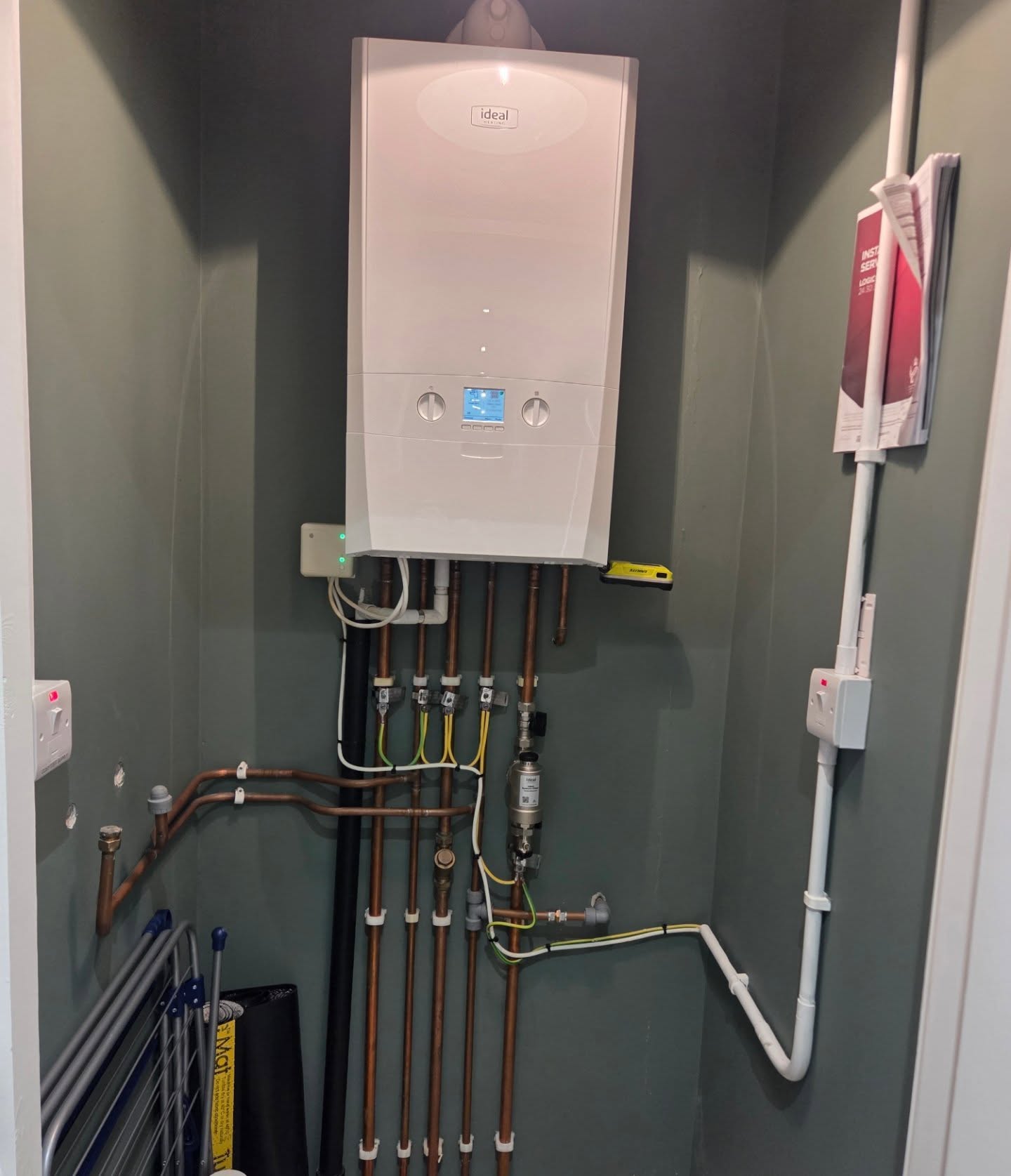
For single-bathroom properties, combi sized to measured flow rate is the standard answer. For two bathrooms, switch to system + 180L unvented cylinder in the airing cupboard. Remove the loft tank. Re-balance rads at commissioning. Seal the flue penetration through insulation properly.

03 · c. 1968-1989

1970s-80s suburban semi

BT19

Private-sale semis and end-terrace estates across Broadway, Rathgael and Balloo. Three-bed standardised layouts, 85-110 sqm, front garden, integral garage on later examples.

Typical setup

Combi or system boiler in kitchen or garage, 15mm / 22mm copper to modern installation standards, typical Worcester Greenstar, Vaillant ecoTEC, Ideal Logic specification in recent upgrades. Single-panel rads one per room, correctly sized at build.

Common issues

  • Garage-sited boiler without adequate frost protection, condensate freezing in January cold snaps.
  • Original 1970s rads retained with a newer boiler, now undersized after loft and cavity insulation upgrades.
  • Magnetic filter absent on pre-2012 install, full system sludge accumulated.
  • Thermostat position inherited from original layout, often on a cold hallway wall.
  • Filling loop flexi-hose left permanently connected.

Best practice on replacement

Like-for-like combi or system swap. Fit magnetic filter. Upgrade filling arrangement to a compliant fixed loop. Add frost-protection thermostat in garage. Relocate room thermostat or upgrade to smart control.

04 · c. 1990-2015

'Gold coast' 1990s-onwards executive detached

BT19BT20

Four- and five-bed detached executive homes across Ballyholme, Groomsport, Crawfordsburn and Helen's Bay. Larger plots, multi-bathroom layouts (two-to-three bathrooms standard, four on larger examples), integral garage or detached outbuildings. 140-220 sqm.

Typical setup

Split between combi and system + unvented cylinder depending on vintage and builder. Many earlier 1990s examples fitted a 28-30kW combi that is now under-spec for current household demand. Later 2000s-onwards builds fitted system boiler + 180-250L unvented cylinder. Underfloor heating on kitchen extensions added in the 2010s.

Common issues

  • Under-spec combi for the household's actual simultaneous-demand pattern, showing up as cold showers when the kitchen tap is running.
  • Original unvented cylinder expansion vessel failed, discharge relief valve weeping to the tundish.
  • Underfloor heating zone not responding because the mixer blending valve is stuck or an actuator has died.
  • Boiler sited in garage without frost protection.
  • Legacy open-vent primary on the underfloor retrofit creating an oxygen-ingress corrosion problem in the sealed system.

Best practice on replacement

Flow-rate and simultaneous-demand survey before specifying. Most correct answer is a system boiler (Vaillant ecoTEC Plus 32 / Viessmann Vitodens / Worcester CDi) with a 210-250L unvented cylinder sized to household pattern. Replace expansion vessel on any system install. UFH zones require specific commissioning: flow-temperature blending, actuator test, thermostat pairing.

05 · c. 2000-present

Bangor marina and modern apartment

BT19BT20

Apartment developments around Bangor Marina, Queen's Parade regeneration schemes and along the Shore Road. One- to three-bed layouts, typically 50-100 sqm. Shared risers, communal corridors.

Typical setup

Individual gas combi in a utility cupboard is the most common setup, some newer developments using heat interface units (HIUs) on a shared heating plant. Pipework in plasterboarded risers. Flue exits through a shared façade or terminates into a communal duct, depending on design.

Common issues

  • Boiler cupboard with inadequate ventilation or servicing clearance.
  • Shared-façade flue termination requiring management-company sign-off for any boiler swap.
  • HIU filter clogged on shared-heating blocks, reducing flow to the flat.
  • Concealed pipework making fault diagnosis destructive.
  • Upper-floor flats running below target mains pressure due to riser losses.

Best practice on replacement

Confirm management-company consent before any flue or external work. Size to measured flow at the flat tap, not the riser nominal. For HIU-served blocks, work is limited to the HIU; the heat-source plant is a block-level decision.

Technical constraints

Pressure, flues and planning.

The bits of a boiler install that determine whether your quote is realistic or optimistic. Most of these are checked at survey, not after.

Mains pressure and flue routing

NI Water supplies Bangor with average mains pressure around 3-3.5 bar, but the town's elevation profile matters: properties near the seafront on the flat sit closer to target pressure, while streets climbing up the Silverbirch / Crawfordsburn side can drop meaningfully at peak demand. Flow-rate testing at the tap is essential for any combi spec. Flue materials are the Bangor-specific issue: coastal postcodes accelerate corrosion on stainless and aluminium flue components, so specify coastal-rated flue with regular inspection. Condensate routing matters in cold snaps — external runs should be insulated minimum 32mm internal bore with continuous fall, and Bangor gets enough hard-frost days in winter to make an unprotected external condensate a reliable call-out.

Planning constraints

Bangor has conservation areas covering Seacliff Road, parts of Queen's Parade, the Old Bangor / Church Street core and Princetown Road. Listed seafront properties add a Listed Building Consent layer. External flues, condensate pipes or extraction grilles on front-facing elevations in these areas may require planning consent. Rear-facing or side-return flue routes usually avoid the issue. The Crawfordsburn Conservation Area also covers historic village cores inland. For a standard Broadway or Rathgael install, planning is not normally an issue.

Honest scope

What we refer out in Bangor.

Gas Safe and OFTEC registered means gas, oil and plumbing. Other trades need other qualifications, and we'd rather say so than pretend.

  • EICR electrical safety inspections and electrical installation work (NICEIC / ECA electrician).
  • Fire risk assessments and fire-safety compliance for seafront holiday lets (fire-safety consultant).
  • Heat pump installation for off-gas properties (MCS-accredited installer).
  • Chimney sweeping and heritage-sensitive capping on Bangor period stock (HETAS sweep).
  • Commercial gas work on Bangor Marina retail and hospitality premises (commercial-registered Gas Safe engineer).

Neighbourhoods we cover

Working across Bangor.

If your address sits in any of these, or between them, we'll be with you the same week.

  • Bangor West
  • Ballyholme
  • Groomsport
  • Helen's Bay
  • Crawfordsburn
  • Bangor Marina
  • Broadway

Common questions

Bangor FAQ.

Why is coastal flue corrosion worse than inland?

Airborne chloride from sea spray reacts with the stainless steel and aluminium used in modern flue systems and heat exchangers. The closer you are to the shoreline, the faster the surface pitting starts. Ten-month-old flues on BT20 Shore Road installs have been condemned where identical flues inland are fine at five years. Annual inspection catches pitting before it becomes perforation.

Our 30kW combi runs two showers fine in summer but chokes in winter. Why?

Combi boilers are rated at a 35°C temperature rise from the incoming cold. In summer the cold mains is ~12°C so the 30kW delivers rated flow. In winter the cold is ~5°C, so the same boiler has to work harder to deliver the same temperature and flow drops. If two bathrooms use simultaneously in January, a 30kW combi is below spec. A system boiler with a stored hot water cylinder doesn't have this issue because the cylinder is heated ahead of demand.

We're converting a Victorian seafront terrace to a holiday let. What's the compliance overhead?

Annual CP12 (legal requirement, same as residential let). Commercial-grade carbon monoxide alarms in each room with a gas appliance. Heat and smoke detection to NI Fire Safety Regs 2010 (not same scope as residential, need separate inspection). Booking platforms expect current gas safety evidence on file. We issue the CP12 on the day of service; the other items are referred to a specialist fire-safety contractor.

Our Ballyholme home has three bathrooms and the builder fitted a combi. Is it salvageable?

Sometimes. Rule of thumb: if the incoming mains flow rate measures 15+ l/min and only two bathrooms are ever used simultaneously, a larger combi (35-42kW output) can work. Below 15 l/min, or regular three-bathroom simultaneous use, the right answer is a system boiler plus a 210-250L unvented cylinder, sized to household pattern. Typical Ballyholme install £3,500-£4,500 including Building Control G3 notification.

Can you reach us if we're in Groomsport or Crawfordsburn?

Yes, 35-40 minutes from Belfast. Same-week for standard work; same-day for emergencies during business hours, Saturday emergency cover as standard in BT19 and BT20.

Get in touch

Need a boiler engineer in Bangor?

Send your postcode and what you need. Same-day response on working days. Or send an emergency request.

We respond the same working day. For anything urgent, send an emergency request.

Get a quote Emergency