Skip to content

Newtownabbey · BT36 · BT37

Plumbers in
Newtownabbey.

Newtownabbey is where Belfast's post-war expansion spilled north. The housing mix is mostly 1950s-80s, Phoenix gas-heated, and back-boiler conversions are still coming out of living rooms three decades after they stopped being specified.

Gas Safe registered | OFTEC registered | 10+ years on the tools
Boiler work in Newtownabbey, Belfast

About the area

Post-war Newtownabbey: back-boilers, ageing Housing Executive systems, and a coastal strip that burns through flues faster than inland.

Newtownabbey sits on the Phoenix Natural Gas network, so almost all work is gas. The housing stock is dominated by post-war Housing Executive and 1970s-80s private estates, which means boiler replacements, back-boiler conversions and power flushing on ageing systems make up the bulk of call-outs. The Whiteabbey coastal strip needs more attention than inland streets because of sea-air flue corrosion.

Newtownabbey borough merged with Antrim in 2015, but the residential footprint still traces the BT36 and BT37 postcodes from Longlands and Whiteabbey along the M2 out through Glengormley, Carnmoney and Mossley. The character is suburban commuter: short drive to the city, big share of post-war and 1970s-80s owner-occupier stock. Ulster University's Jordanstown campus has been scaling down since 2022, but legacy student-let stock remains across BT37 with its own CP12 and rental-standards overhead. Heating patterns across the borough are consistent: Phoenix combi on almost every street, with a meaningful minority of original back-boilers still running in un-modernised 1970s interiors.

Gas network
Phoenix Natural Gas
Drive time
15 minutes from Belfast city centre
Postcodes covered
BT36BT37
Main focus
Gas Boiler Installation · Boiler Servicing · Boiler Repair

How we work here

What Newtownabbey homes need.

Every area has its own housing stock and heating mix. Here's how that shapes the work we do in Newtownabbey.

Housing stock

Large post-war Housing Executive estates in Longlands, Rathfern and Ballyduff; 1970s-80s private semis and detached through Glengormley, Carnmoney and Mossley; 1990s-onwards infill towards Jordanstown; Victorian and interwar villa frontage along the Whiteabbey Shore Road; modern apartments around Abbey Centre and the motorway junction.

Heating pattern

Phoenix Natural Gas network-wide, roughly 95% gas coverage. Combi boilers (typically 24-30kW) dominate. A persistent minority of back-boilers behind gas fires still in service in un-modernised 1960s-70s interiors. System boilers with unvented cylinders appear in larger Jordanstown and Whiteabbey detached homes.

Common jobs in Newtownabbey

  • Back-boiler removal and conversion to wall-mounted combi, consistently the most common Newtownabbey job.
  • Combi swaps in 1970s Housing Executive semis where the original upgrade boiler is now 10-15 years old.
  • Annual servicing with flue integrity checks across the Whiteabbey coastal strip.
  • Landlord CP12s across BT37 legacy student-let stock.
  • Power flushing on 1970s-80s estate systems with visible sludge at radiator bleed points.
  • Emergency call-outs in cold snaps, concentrated on ageing Worcester, Baxi and Vaillant units.
  • Unvented cylinder installs replacing loft tanks in Whiteabbey period frontage property.

Local considerations

Things to know in Newtownabbey.

Back-boiler systems are regulated legacy kit: combined gas-fire-and-boiler units behind a living-room fireplace. No modern boiler is still made in this form factor. Removal requires gas-feed capping, chimney-void assessment, and finding somewhere else in the house for the new combi, usually a kitchen or utility wall.

Whiteabbey seafront properties sit in a salt-air envelope that accelerates flue corrosion meaningfully. Annual service with flue integrity check is the baseline; some manufacturers make it a warranty condition for coastal-postcode installs.

Parts of Carnmoney and upper Glengormley sit at elevation and report lower mains-water pressure at peak demand. Any combi specification needs a measured flow-rate test, not a catalogue assumption.

Housing stock in depth

Property types and what they need.

Newtownabbey is not one kind of house. Each era has a different pipework shape, different failure modes, and a different correct answer on replacement. Here's how that plays out on the ground.

01 · c. 1945-1968

Post-war Housing Executive semi

BT36BT37

Standardised three-bed semi stock across Longlands, Rathfern, Ballyduff and the older parts of Monkstown. Cavity-wall brick or rendered, pitched roof, compact footprint of 75-90 sqm. Originally heated by a coal back-boiler, converted to gas back-boiler in the 1970s Phoenix rollout.

Typical setup

Either a back boiler still in the living-room fireplace (unmodernised), or a wall-mounted combi fitted during a later NIHE upgrade programme. Pipework 15mm / 22mm copper, sometimes with legacy lead gas tails from the meter. Radiators single-panel 600mm, one per room, typically undersized for current insulation standards.

Common issues

  • Back boiler still operational but at 60-65% efficiency and with declining parts availability.
  • Post-conversion pipework routed awkwardly, with visible surface runs where the back-boiler primary was re-used instead of replaced.
  • Gas meter tails in lead or early copper showing age-related joint weep.
  • Radiator balancing never revisited after the conversion, upstairs rooms hot and downstairs tepid.
  • Room thermostat sited in a cold north-facing hallway, giving misleading demand signal to the boiler.

Best practice on replacement

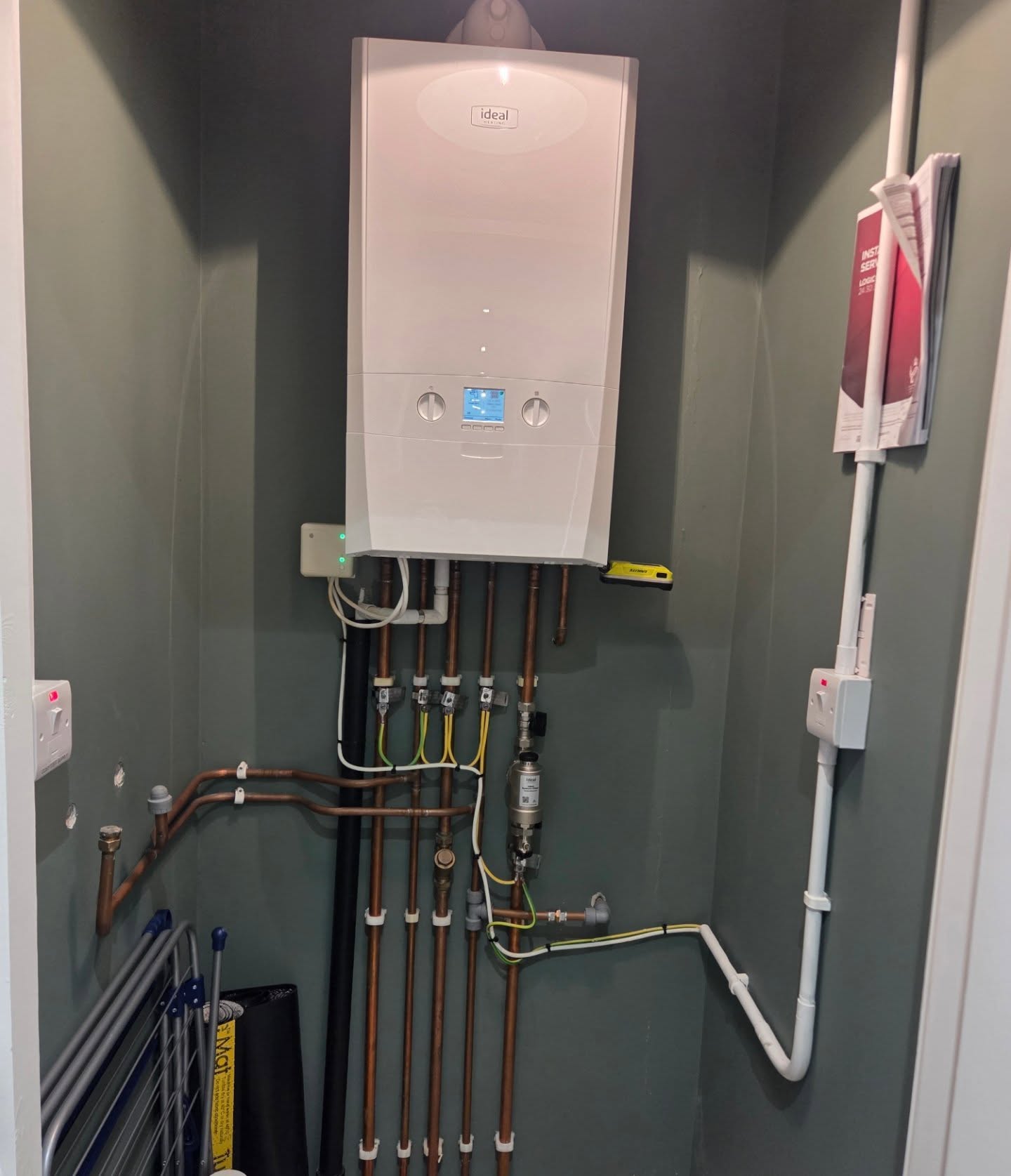
Remove the back boiler and gas fire; cap and test-tight the gas feed. Fit a modern combi on a kitchen or utility wall with compliant flue routing. Upgrade meter tails if pre-1990. Install a magnetic filter. Balance every radiator at commissioning with a flow-meter, record flow per room. Relocate or replace the room thermostat to a representative living-space position, or specify a smart thermostat with a dedicated sensor.
02 · c. 1968-1989

1970s-80s private semi and detached

BT36BT37

Private-sale three- and four-bed semis and detached homes across Glengormley, Carnmoney, upper Whiteabbey and Mossley. Cavity-wall brick or render, 90-120 sqm, attached garage or side driveway common. Some properties sit at elevation on the Cave Hill / Carnmoney side.

Typical setup

Combi or system boiler fitted during a 2000s-2010s upgrade, typically in a kitchen or garage. System boilers paired with airing-cupboard cylinders where two bathrooms justified it. 15mm / 22mm copper throughout to current installation standards. Pressurised sealed-system primaries on most.

Common issues

  • Boiler in garage with inadequate frost protection; condensate freeze-ups in cold snaps.
  • Elevated streets (upper Carnmoney, Cave Hill side of Glengormley) running below target mains pressure at peak demand.
  • Pressure-relief valve passing water into the condensate line, masking expansion-vessel failure.
  • Room thermostat on a north-facing hall wall, giving unstable cycling.
  • Radiators from original 1970s install now undersized for current insulation levels and use patterns.

Best practice on replacement

Measure incoming flow rate before committing to combi or system. For garage-sited boilers, specify frost-protection thermostat and run condensate to an internal soil stack wherever geometry allows. Replace expansion vessel and fit magnetic filter. Review radiator sizing against current room use; an under-radiated lounge is cheaper to fix on a boiler changeover than later.

03 · c. 1890-1939

Whiteabbey coastal frontage property

BT37

Victorian and interwar villas and semis along the Shore Road, facing Belfast Lough. Larger plots than the inland stock, bay-fronted, 110-160 sqm. Some later 1970s-80s infill between older properties.

Typical setup

System boiler with an unvented cylinder in many cases given the size and multi-bathroom use. Pipework mixed: original copper from retrofits, some legacy 22mm microbore sections. Flues typically exit to the side or rear elevation to preserve the seafront façade.

Common issues

  • Accelerated flue corrosion from chloride-rich sea air; stainless flue sections often show surface pitting within 3-5 years.
  • Aluminium heat-exchanger corrosion in lower-spec boilers over 8-10 year service life.
  • Render cracking around the flue penetration letting moisture ingress on cavity-wall construction.
  • Condensate discharge to an external gully freezing in cold coastal snaps.
  • Original cast-iron radiators with sludge build-up from decades of sealed-system additions.

Best practice on replacement

Specify a boiler with a cast-iron or stainless-steel heat exchanger (Viessmann, Vaillant ecoTEC Plus) for coastal longevity, not lowest-spec aluminium. Relocate condensate internally if possible. Annual-service commitment from the owner at install time; suggest booking the next service at commissioning. Consider a heritage-appropriate flue terminal colour to minimise visual impact on a front elevation.

04 · c. 1990-2015

1990s-onwards private estate

BT36BT37

Three- and four-bed estate homes across Jordanstown, Mossley Hill and the infill developments between the older Glengormley streets. Designed for Phoenix gas from build. Consistent layout, 110-140 sqm.

Typical setup

Combi or system + unvented from original specification. Pipework to modern installation standards. Radiators correctly sized to the rooms as built. Condensate routed internally. Often a garage-sited boiler with a utility cold-feed and outside tap off the same run.

Common issues

  • Original build boiler hitting 20+ years with parts availability narrowing.
  • Filling loop flexi-hose left in place permanently instead of a compliant fixed arrangement.
  • Garage frost-protection absent or disabled.
  • Unvented cylinder expansion-relief valve weeping into the tundish, indicating vessel pre-charge loss.
  • Magnetic filter absent on pre-2012 installs.

Best practice on replacement

Straight combi-for-combi or system-for-system swap. Fit magnetic filter. Replace flexi-hose with a compliant fixed filling arrangement. Verify tundish discharge meets G3 requirements. Upgrade smart-stat controls if the customer wants modern scheduling.

Technical constraints

Pressure, flues and planning.

The bits of a boiler install that determine whether your quote is realistic or optimistic. Most of these are checked at survey, not after.

Mains pressure and flue routing

NI Water mains pressure across Newtownabbey varies more than the postcode-wide average because of elevation. Streets on the Cave Hill / Carnmoney side, upper Glengormley and parts of Mossley Hill sit at altitude and report noticeably lower pressure at peak domestic demand than the coastal Shore Road properties. Any combi install in the borough should follow a measured flow-rate test (minimum 60 seconds, timed-bucket method) at the kitchen tap. Flue routing on 1970s-80s semis is usually straightforward, but coastal Whiteabbey positions need higher-spec flue materials: stainless steel rated for coastal exposure, with a service interval that catches pitting before it becomes perforation. Gas Safe MI distances (300mm from openable windows, 600mm from boundary, 200mm above ground, 1200mm from opposing openings) apply equally to inland and coastal.

Planning constraints

No large conservation areas in the core residential footprint. A handful of listed buildings in historic Whiteabbey village and around Monkstown Castle need Listed Building Consent for external work. Most Newtownabbey suburban installs are not planning-constrained; a straightforward back-boiler-to-combi conversion with a rear-elevation flue is permitted development in almost all residential streets. Apartment installs at Abbey Centre and around the motorway junction may need management-company consent for flue routing through a shared elevation.

Honest scope

What we refer out in Newtownabbey.

Gas Safe and OFTEC registered means gas, oil and plumbing. Other trades need other qualifications, and we'd rather say so than pretend.

  • EICR electrical safety inspections and any electrical installation work (NICEIC / ECA electrician).
  • Chimney sweeping and capping on post-conversion chimney voids (registered sweep + HETAS for solid-fuel reinstatement).
  • Structural alteration for boiler relocation where a wall needs opening up (building contractor).
  • Commercial gas work across the Mallusk and Newtownabbey business parks (commercial-registered Gas Safe engineer).
  • Solid-fuel stove reinstatement on conservation-area chimneys where the back-boiler came out (HETAS installer).

Neighbourhoods we cover

Working across Newtownabbey.

If your address sits in any of these, or between them, we'll be with you the same week.

  • Glengormley
  • Monkstown
  • Jordanstown
  • Rathfern
  • Ballyduff
  • Carnmoney
  • Whiteabbey
  • Longlands

Common questions

Newtownabbey FAQ.

What exactly is a back boiler, and why do they need replacing?

A back boiler is a gas-fired water heater built into the back of a living-room fireplace, with a decorative gas fire in front. Common in 1960s-80s Newtownabbey houses. They run at around 60-65% efficiency (modern boilers: 92%+), can't easily be serviced without dismantling the fireplace, and parts availability is now poor. Replacement frees up living-space floor area and typically cuts gas bills 25-30%.

How do you decide where the new boiler goes if we remove a back boiler?

Kitchen or utility wall, on a compliant flue route. We check: flue clearances to the nearest window / door / boundary, gas supply pipe sizing from the meter (often needs upgrading from the 15mm/22mm original to 22mm/28mm), and condensate discharge path. Ideal, Worcester and Vaillant all make compact combis that suit a Newtownabbey kitchen cupboard.

How do flues work on a 1970s Housing Executive semi?

Usually through the external kitchen or utility wall, 300mm from any openable window and 600mm from the boundary with the next property. On a semi, the terminal sits well clear of the neighbour. On a coupled pair or end-terrace configuration, we core a new position rather than re-using an old flue hole, because the regulations have tightened since the 1980s and old positions often won't comply today.

Our Whiteabbey property has had three boilers in twenty years. Is that normal for coastal?

Higher than inland, yes. Sea-air chloride attacks stainless-steel flue components and aluminium heat exchangers. The fix is not a different boiler but a stricter service regime: annual service with full flue inspection, combustion analysis, and replacement of any flue section showing surface pitting. We've kept correctly-serviced coastal boilers running reliably to 15+ years.

How quickly can you reach Newtownabbey?

15 minutes from Belfast city centre, 20 to the outer Glengormley and Mossley streets. Same-week for standard work, same-day for emergencies in business hours.

Get in touch

Need a boiler engineer in Newtownabbey?

Send your postcode and what you need. Same-day response on working days. Or send an emergency request.

We respond the same working day. For anything urgent, send an emergency request.

Get a quote Emergency