Skip to content

Comber · BT23

Plumbers in
Comber.

Comber is a market town at the head of Strangford Lough. Phoenix gas reached the town in the mid-2000s, so there's a meaningful stock of post-conversion houses still on their first gas boiler, alongside older rural-edge properties running oil.

Gas Safe registered | OFTEC registered | 10+ years on the tools
Boiler work in Comber, Belfast

About the area

Comber's conversion-era gas stock is hitting the first replacement cycle. Distinctive wave not seen in older gas areas.

Phoenix Natural Gas covers most of Comber proper. The rural edge towards Killinchy and Ballygowan stays oil-heated. Because Phoenix arrived relatively late here, the local stock of conversion-era gas boilers (fitted 2005-2015) is now approaching its first replacement cycle, which is a distinctive Comber pattern.

Comber has around 10,000 residents and serves as a commuter town for Belfast and Newtownards alongside its own local economy. The centre retains Victorian and Georgian grain around The Square, Castle Street and Killinchy Street. Residential expansion through the 1970s-2000s filled in off the Ballygowan, Killinchy and Belfast Roads. Larger detached family homes line the elevated ridge between Comber and Newtownards. The Phoenix network connected the town in the mid-2000s, and conversion boilers fitted at that time are now hitting the 15-20 year mark. Newer 2010s-onwards developments were gas from build.

Gas network
Phoenix Natural Gas
Drive time
25 minutes from Belfast city centre
Postcodes covered
BT23
Main focus
Oil to Gas Conversion · Gas Boiler Installation · Oil Boiler Servicing

How we work here

What Comber homes need.

Every area has its own housing stock and heating mix. Here's how that shapes the work we do in Comber.

Housing stock

Victorian and Georgian stock around The Square and historic centre; 1970s-80s semi-detached stock on Killinchy Road estates; 1990s-2000s private estates off the Ballygowan Road; 2010s-onwards newer family developments; larger detached homes along the Comber-Newtownards ridge.

Heating pattern

Phoenix Natural Gas across most of Comber proper (roughly 80% of town stock). Oil-heated rural-edge and farm properties towards Killinchy and Ballygowan. Combi boilers dominant on newer estates, system boilers with cylinders on larger ridge properties, oil on the rural fringe.

Common jobs in Comber

  • Replacement of conversion-era gas boilers fitted during the mid-2000s Phoenix connection programme, now reaching end-of-life.
  • Oil-to-gas conversion on the remaining oil-heated streets where Phoenix has extended coverage.
  • OFTEC oil servicing on rural farms and larger houses towards Killinchy.
  • Annual gas servicing across the town proper.
  • System boiler + unvented cylinder installs on ridge properties with multi-bathroom demand.
  • Power flushing on 1970s-80s systems showing magnetite sludge.
  • Landlord CP12s across the town-centre rental stock.

Local considerations

Things to know in Comber.

Comber's conversion-era boilers (2005-2015 Phoenix connection) are a specific replacement wave. These were often builder-spec or NIHE-programme installs, so magnetic filters are commonly absent and sludge accumulation is well advanced.

Ridge properties between Comber and Newtownards report lower mains-water pressure at peak demand because of elevation. Flow-rate testing matters more here than on flat town-centre streets.

Oil tanks on rural Comber properties are often 25+ years old and at end-of-life on condition grounds regardless of function.

Housing stock in depth

Property types and what they need.

Comber is not one kind of house. Each era has a different pipework shape, different failure modes, and a different correct answer on replacement. Here's how that plays out on the ground.

01 · c. 2005-2015 (gas fit date, house age older)

Conversion-era gas semi or detached

BT23

Properties that were oil-heated before the mid-2000s Phoenix connection and converted to gas during the initial programme. The house itself is typically 1970s-90s build; the boiler is much more recent. Combi boiler in kitchen or utility, legacy oil tank often still in the garden awaiting decommission.

Typical setup

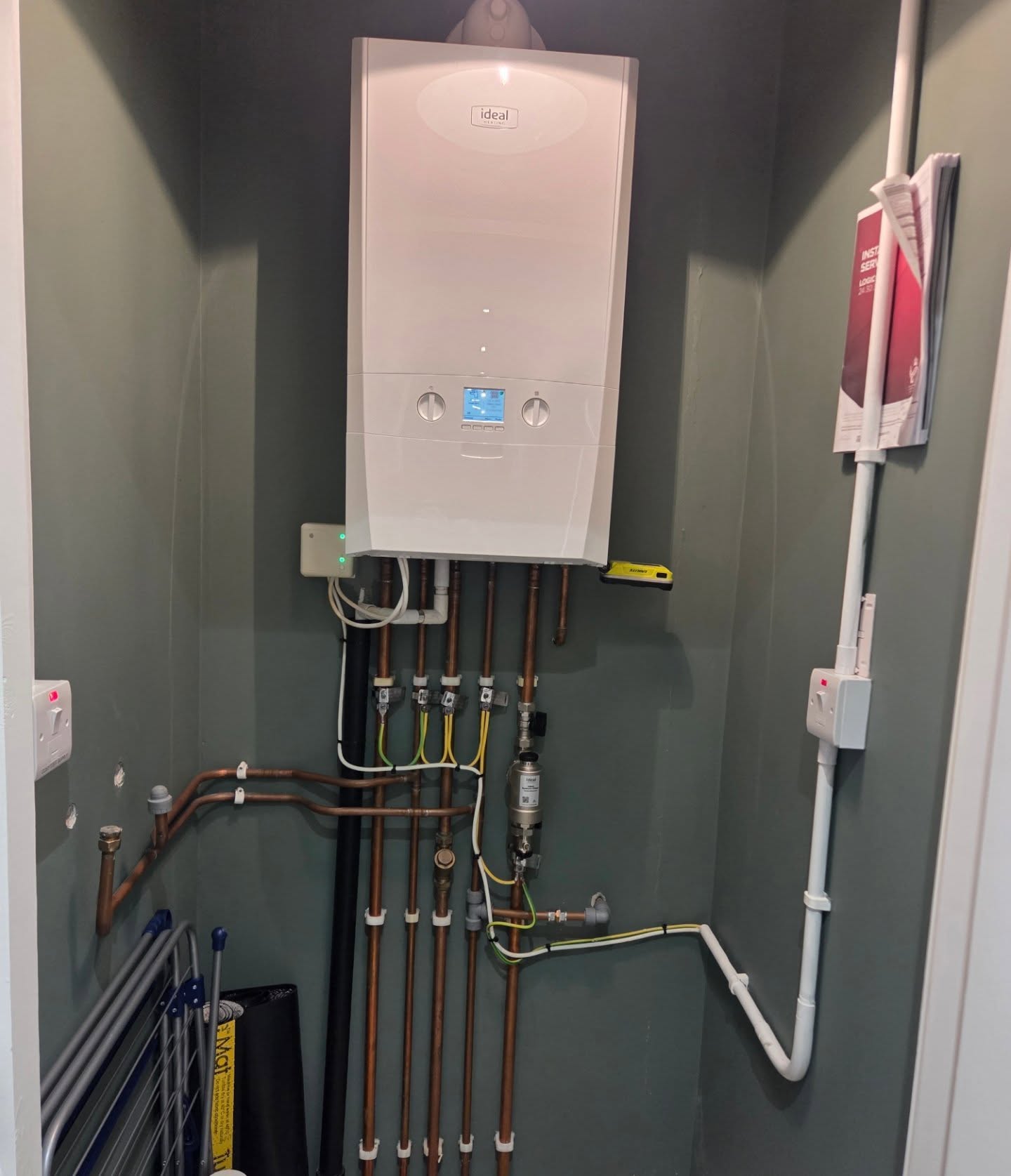
Combi boiler (Worcester Greenstar, Vaillant ecoTEC, Ideal Logic) from conversion programme. Legacy pipework retained where suitable, new 15mm / 22mm runs to the boiler. Radiators original to the older house.

Common issues

  • Magnetic filter absent on conversion-era installs.
  • Residual oil-system sludge never properly flushed during conversion.
  • Original radiators now undersized for current insulation standards.
  • Legacy oil tank still in the garden, weathering and an eyesore.
  • Condensate discharge routed externally to an oil-era gully, freeze-risk.

Best practice on replacement

Full chemical flush + magnetic filter fit at replacement. Consider system filter retrofit even without boiler swap if the install is sludgy. Remove legacy oil tank during the boiler changeover job. Reroute condensate internally where possible. Review radiator sizing against current insulation.
02 · c. 1972-1989

1970s-80s Killinchy Road estate semi

BT23

Private-sale three-bed semis along Killinchy Road, Ballygowan Road and Castle Road. Cavity-wall brick, pitched roof, 90-110 sqm.

Typical setup

Originally oil-heated with external tank. Post-2005 Phoenix conversion fitted a combi. Pipework mixed eras. Single-panel radiators from original build or early upgrade.

Common issues

  • Same conversion-era pattern as above.
  • Garage-sited boiler without frost protection.
  • Room thermostat sited in a cold hallway.
  • Expansion vessel pressure loss on sealed-system variants.

Best practice on replacement

Full flush + magnetic filter. Frost-stat on garage installs. Smart thermostat to fix the hallway-sensor issue. Replace expansion vessel on system swaps.

03 · c. 1990-2015

Comber-Newtownards ridge detached

BT23

Four- and five-bed executive detached homes along the elevated ridge between Comber and Newtownards, often with two or three bathrooms and larger plots. 130-190 sqm.

Typical setup

Combi or system + unvented depending on vintage. Higher elevation affects incoming mains pressure at peak demand.

Common issues

  • Under-spec combi for multi-bathroom simultaneous draw given ridge pressure.
  • Unvented cylinder expansion vessel pre-charge loss.
  • UFH zone drift on kitchen extensions added in the 2010s.
  • Original builder-spec boiler now 20+ years old.

Best practice on replacement

Flow-rate and simultaneous-demand survey. System + unvented usually the correct answer for two-plus bathrooms on ridge pressure. Replace expansion vessel. Commission UFH zones properly.

Technical constraints

Pressure, flues and planning.

The bits of a boiler install that determine whether your quote is realistic or optimistic. Most of these are checked at survey, not after.

Mains pressure and flue routing

NI Water mains pressure in Comber sits around 2.8-3.3 bar at the boundary. Ridge properties between Comber and Newtownards report lower pressure at peak demand, typical drop of 0.5-1.0 bar. Combi spec should follow measured flow rate (timed-bucket method, 60-second minimum). Flue routing follows Approved Document J / Gas Safe MI distances. Condensate discharge routing matters; external runs on the ridge exposure need insulation and continuous fall.

Planning constraints

The Square and parts of Comber historic centre sit within a conservation area. External flues, condensate pipes and extraction grilles on front-facing elevations near the square may need planning consent. A handful of listed buildings around the square add a Listed Building Consent layer. Suburban streets off the Ballygowan and Killinchy Roads have no conservation overlay.

Honest scope

What we refer out in Comber.

Gas Safe and OFTEC registered means gas, oil and plumbing. Other trades need other qualifications, and we'd rather say so than pretend.

  • EICR electrical safety inspections and electrical installation work (NICEIC / ECA electrician).
  • Oil tank decommissioning with contamination assessment (specialist environmental contractor).
  • Air-source heat pump installation on off-gas rural properties considering alternatives (MCS-accredited installer).
  • Commercial gas work in Comber industrial units (commercial-registered Gas Safe engineer).

Neighbourhoods we cover

Working across Comber.

If your address sits in any of these, or between them, we'll be with you the same week.

  • Comber town
  • The Square
  • Ballygowan Road
  • Killinchy Road
  • Castle Lane

Common questions

Comber FAQ.

Our gas boiler is from 2008 when we converted. Worth replacing?

Probably yes. Early-programme conversion boilers (2005-2012 era) are often 80-85% efficient versus 94%+ on modern A-rated units. If magnetic filter was never fitted and the system hasn't been flushed, sludge is also reducing efficiency further. Typical gas-bill saving on replacement £200-£400/year; payback 5-7 years on a £2,000-£2,500 install.

We're on the ridge and hot-water pressure is poor. What's the fix?

Two options. A system boiler with an unvented cylinder stores mains-pressure hot water so flow is strong regardless of instantaneous draw. Alternatively, an incoming mains pressure booster pump (sized correctly, typically 2-3 bar boost) can be fitted for combi specs where a cylinder isn't wanted. We measure flow rate at survey before recommending.

Does Phoenix reach Killinchy direction?

Partially. Phoenix has extended along the Killinchy Road in recent years but hasn't reached the village core. Send us the full postcode and we'll check coverage before quoting any oil work.

Can you get to Comber in an emergency?

25 minutes from Belfast. Same-day response for emergencies in business hours.

Get in touch

Need a boiler engineer in Comber?

Send your postcode and what you need. Same-day response on working days. Or send an emergency request.

We respond the same working day. For anything urgent, send an emergency request.

Get a quote Emergency